
Introduction
Dear All,
It is time for an update from Population Crisis.
The dominant online conversation about population has shifted dramatically. Where countless videos once focused on overpopulation, they now increasingly analyze impending population decline.
In the Western world, the prevailing narrative is one of growing alarm over demographic trends. The story has become a familiar, depressing refrain. Until around 2010, the primary fear was of nations overflowing with people. Today, prominent voices like Elon Musk warn of a coming “population dearth” with Western societies failing to produce enough children to support the children of young parent families and their aging populations.
We are indeed witnessing profound and often unpredictable demographic transformations. By 2050, the global population landscape will be fundamentally reshaped, driven largely by plummeting fertility rates—a trend now visible even in Africa.

Global Fertility Rate Snapshot (TFR – Total Fertility Rate)
| Country | 2000 | 2025 (Est.) |
|---|---|---|
| Kenya | 3.66 | 3.12 |
| Egypt | 3.15 | 2.71 |
| India | 3.11 | 1.94 |
| United States | 2.06 | 1.60 |
| Tunisia | 2.04 | 1.56 |
| Mexico | 2.67 | 1.55 |
| United Kingdom | 1.74 | 1.54 |
| Hungary | 1.25 | 1.50 |
| Turkey | 2.16 | 1.48 |
| Brazil | 2.13 | 1.47 |
| Russia | 1.25 | 1.47 |
| Germany | 1.38 | 1.46 |
| Iran | 2.20 | 1.44 |
| France | 1.75 | 1.40 |
| Sri Lanka | 1.98 | 1.37 |
| Greece | 1.33 | 1.34 |
| Japan | 1.41 | 1.23 |
| Bosnia & Herzegovina | 1.71 | 1.20 |
| Italy | 1.18 | 1.20 |
| Colombia | 2.69 | 1.09 |
| China | 1.82 | 1.02 |
| Thailand | 1.88 | 0.98 |
| Singapore | 1.16 | 0.96 |
| South Korea | 1.72 | 0.75 |
This decline will drastically impact population sizes. For example, South Korea, with a current population of 50 million, is projected to shrink to just 20 million within two generations.
After extensive research and media analysis, I find one of the clearest summaries of this global trend to be a short BBC video podcast.
“Why fertility and birth rates are falling – The Global Story podcast, BBC World Service.”
You can watch it here:
The core message from Population Crisis is this: we now have the research and data to assess whether a nation is living sustainably. For the 85% of the world’s population residing in unsustainable countries, a long-term population decrease may be beneficial.
The critical challenge is not the decline itself, but its pace. The severity of the societal impact will depend entirely on how well a country organizes itself to meet the needs of a growing elderly population.
The reasons for declining fertility are complex and interconnected. In the United States, for instance, a significant drop in teenage pregnancy contributed to the fall from a TFR of 2.1 in 2003 to 1.62 in 2023.
Other key factors include:
Postponement of Family Formation:
Delaying childbirth, beginning in the teenage years and extending through one’s twenties, is a primary driver of lower period fertility rates.
Socioeconomic and Cultural Shifts:
Young people are socializing less. Dating and marriage rates have fallen rapidly in the West and parts of Asia, with 56% of millennials never marrying. Research from institutes like the IFS points to declining cohabitation and reduced social interaction.
Changing Economic Rationale for Marriage:
Historically, marriage offered economic benefits, adult status, stability, and a socially sanctioned sexual relationship. Modern conveniences (e.g., vacuums, microwaves) reduced the need for a division of domestic labor, while contraception decoupled sex from marriage.
Cost of Childrearing:
Generation Z widely perceives raising children as prohibitively expensive, leading many couples to forgo parenthood.
Assortative Mating:
The trend toward partnering with someone of similar education and socioeconomic status creates a mismatch, especially as women now outnumber men in higher education. Many women are reluctant to partner with less-educated men.
Housing Affordability:
In China, for example, 70% of women require home ownership before marriage. Studies show a 1% increase in house prices leads to a 0.3% average fall in marriage rates.
A Case Study: Japan
The statistics on cohabitation and “solace time” you provided are drawn from recent Japanese government surveys, highlighting profound social changes:
- Cohabitation Drop: Among 18-29-year-olds, the rate of living with a romantic partner fell from 42% (2014) to 32% (2025).
- Collapse of “Solace Time”: Time spent alone for rest has plummeted from ~128 hours per month (2010) to ~65 hours (2019), with projections as low as ~5 hours by 2025. This indicates extreme social isolation, burnout, and eroded work-life boundaries.
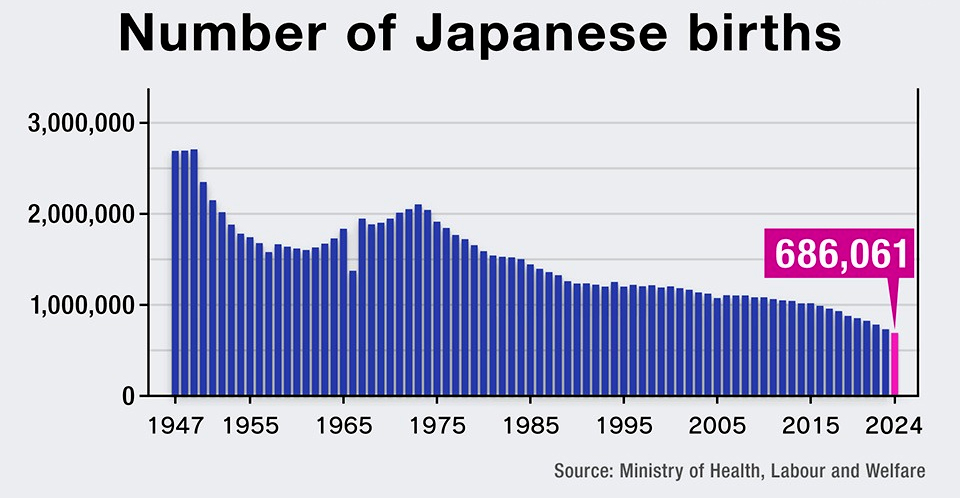
Source : https://www3.nhk.or.jp
This combination paints a stark picture of shifting relationships, work culture, and personal well-being in one of the world’s most rapidly aging societies.
Looking ahead: Sustainability and the future
The future is inherently unpredictable, but current data provides a clear and urgent picture of the demographic challenges ahead.
There are positive outcomes to decreasing populations. Population Concern has consistently advocated for sustainability, and with sustainability comes predictability—namely, a stable climate and a societal system that can plan without needing to change strategy nearly every year. As the human world ages, it may become a wiser one, ennobling its inhabitants with innovations that can be deployed, hopefully, to its own advantage. This might seem utopian to some, but to Population Crisis, it seems like common sense.
Sustainability is a function of human consumption habits and nature’s ability to regenerate the resources consumed, creating a balance between the two. Population Crisis believes population density plays a part in this. If we are to eventually achieve a sustainable balance, human demographics must certainly be a factor. We believe continued research into sustainability will guide us.
As Population Crisis stated in its film “Wake up Planet Earth”:
A sustainable population could be achieved with current consumption habits as follows. Very approximately, for example, some of the following countries would need to lower their populations to roughly:
- Japan to about 40 million
- Egypt to about 20 to 40 million
- UK to 20 to 30 million
- USA to 169 million
- China to 330 million
- India to 470 million
These (very) approximate numbers would depend on factors such as the specific consumption habits if that country (i.e., whether we continue to use fossil fuels, eat meat, damaging mining habits etc.) and whether we wish to increase the area available for wildlife and forestry.